


Immunität

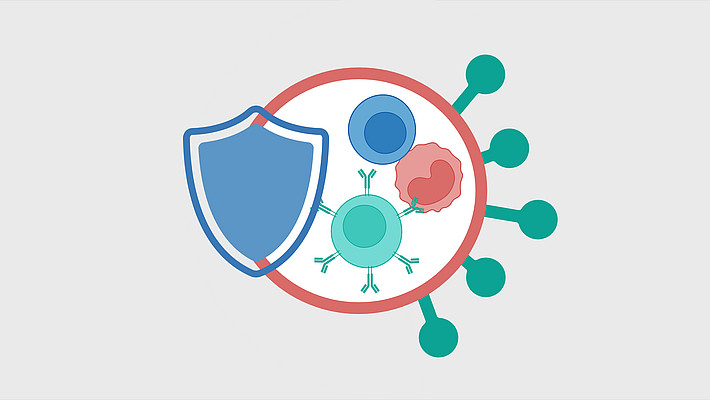
Das Immunsystem ist ein hochkoordiniertes Netzwerk aus Zellen, Molekülen und Geweben, das den Körper vor eindringenden Mikroorganismen, Tumorzellen und anderen Gefahrensignalen schützt. Es gliedert sich in die innate (angeborene) Immunantwort und die adaptive (erworbene) Immunität.

Die innate Immunantwort bildet die erste Verteidigungslinie. Sie besteht aus physikalischen Barrieren wie (Schleim-)Haut, chemischen Faktoren und einer Vielzahl von Zellen, die bestimmte Rezeptoren (pattern‑recognition‑Rezeptoren, kurz PRRs) besitzen, um allgemeine molekulare Muster von Pathogenen (PAMPs) zu erkennen. Zu den Schlüsselfunktionen der angeborenen Immunantwort gehören die Phagozytose durch Makrophagen und dendritische Zellen, die Freisetzung proinflammatorischer Zytokine und die Aktivierung des Komplementsystems, das Pathogene direkt zerstört oder deren Markierung für die Phagozytose verbessert. Natürliche Killerzellen (NK‑Zellen) ergänzen diese Abwehr, indem sie virusinfizierte Zellen abtöten.

Die adaptive Immunität entsteht erst nach einer kurzen Latenz, ist dafür aber hochspezifisch und kann über Jahre hinweg bestehen bleiben. Sie beruht auf B‑Zellen, die Antikörper produzieren, und T‑Zellen, welche die zellvermittelte Immunität ausüben. Dabei werden Immunglobuline (IgG, IgA, IgM) produzieren. Diese Antikörper neutralisieren Viren, markieren sie für die Phagozytose oder aktivieren das Komplementsystem. Gedächtnis‑B‑ und T‑Zellen bleiben im Körper und ermöglichen beim erneuten Kontakt mit dem gleichen Pathogen eine rasche und effektive Reaktion.

Zentrale Regulatoren dieses Netzwerks sind Zytokine‑ und Chemokine, welche die Kommunikation zwischen den verschiedenen Zelltypen steuern, die Entzündungsantwort modulieren und die Balance zwischen Aktivierung und Regulation aufrechterhalten. Störungen dieses Gleichgewichts können zu Immundefekten, Autoimmunität oder überschießenden Entzündungsreaktionen führen.

Das tiefere Verständnis dieser Mechanismen bildet die Basis für Impfstoffdesign, Immuntherapien und die Entwicklung von Strategien zur Modulation übermäßiger Immunantworten bei schweren viralen Erkrankungen. 


Unsere Publikationen

2025

COVID-19 and Influenza Booster Vaccination Elicits Robust Antibody Responses in Patients with Primary Brain Tumors Comparable to Healthy Adults

SARS-CoV-2 Variant-Specific Antibodies in Vaccinated Inflammatory Bowel Disease Patients

Pre-existing neutralizing antibodies against cattle-transmitted influenza A virus H5N1 are detectable in unexposed individuals

2024

Comparison of immune responses to SARS-CoV-2 spike following Omicron infection or Omicron BA.4/5 vaccination in kidney transplant recipients

Hybrid immunity-based induction of durable pan-endemic-coronavirus immunity in the elderly

Characterisation of the antibody-mediated selective pressure driving intra-host evolution of SARS-CoV-2 in prolonged infection

Divergent autoantibody and cytokine levels in COVID-19 sepsis patients influence survival

Detection of low pre-existing humoral immunity against influenza virus H5N1 clade 2.3.4.4b in unexposed individuals

Variant-specific humoral immune response to SARS-CoV-2 escape mutants arising in clinically severe, prolonged infection

Effect of XBB.1.5-adapted booster vaccination on the imprinting of SARS-CoV-2 immunity

Vaccination impairs de novo immune response to omicron breakthrough infection, a precondition for the original antigenic sin

2023

Enhanced SARS-CoV-2 humoral immunity following breakthrough infection builds upon the preexisting memory B cell pool”. Science immunology

Somatic hypermutation introduces bystander mutations that prepare SARS-CoV-2 antibodies for emerging variants

Immune responses in COVID-19 patients during breakthrough infection with SARS-CoV-2 variants Delta, Omicron-BA.1 and Omicron-BA.5

Implementing the Lolli-Method and pooled RT-qPCR testing for SARS-CoV-2 surveillance in schools: a pilot project

Influence of the Single Nucleotide Polymorphisms rs12252 and rs34481144 in IFITM3 on the Antibody Response after Vaccination against COVID-19

Impaired humoral immunity to BQ.1.1 in convalescent and vaccinated patients

Inhibition of p38 signaling curtails the SARS-CoV-2 induced inflammatory response but retains the IFN-dependent antiviral defense of the lung epithelial barrier

Antibody responses elicited by mRNA vaccination in firefighters persist six months and correlate inversely with age and directly with BMI

SARS-CoV-2-specific T cell responses wane profoundly in convalescent individuals 10 months after primary infection 

COVID-19 vaccination in psoriasis patients receiving systemic treatment: A prospective single-center study

Longitudinal monitoring of mRNA-vaccine-induced immunity against SARS-CoV-2

SARS-CoV-2 humoral and cellular immunity following different combinations of vaccination and breakthrough infection

Surrogate Virus Neutralisation Test Based on Nanoluciferase-Tagged Antigens to Quantify Inhibitory Antibodies against SARS-CoV-2 and Characterise Omicron-Specific Reactivity in a Vaccination Cohort

Factors Associated With Vaccine-Induced T-Cell Immune Responses Against Severe Acute Respiratory Syndrome Coronavirus 2 in Kidney Transplant Recipients

Inhibition of cellular RNA methyltransferase abrogates influenza virus capping and replication

Macrophage migration inhibitory factor receptor CD74 expression is associated with expansion and differentiation of effector T cells in COVID-19 patients

2022

Human lungs show limited permissiveness for SARS-CoV-2 due to scarce ACE2 levels but virus-induced expansion of inflammatory macrophages

Serological Markers of SARS-CoV-2 Reinfection

Immunogenicity of bivalent Omikron BA.4/5 adapted vaccine in hemodialysis patients

Significant fade of neutralizing antibodies and stable cellular immunity in 4 times COVID-19 vaccinated non-infected compared to COVID-19 convalescent and 3 times vaccinated hemodialysis patients

3D Ex vivo tissue platforms to investigate the early phases of influenza a virus- and SARS-CoV-2-induced respiratory diseases

Inferior humoral and sustained cellular immunity against wild-type and Omikron variant of concern in hemodialysis patients immunized with 3 SARS-CoV-2 vaccine doses compared with 4 doses

Inferior cellular and humoral immunity against Omikron and Delta variants of concern compared with SARS-CoV-2 wild type in hemodialysis patients immunized with 4 SARS-CoV-2 vaccine doses

SARS-CoV-2 neutralizing human recombinant antibodies selected from pre-pandemic healthy donors binding at RBD-ACE2 interface

Impact of low eGFR on the immune response against COVID-19

SARS-CoV-2 infects and replicates in photoreceptor and retinal ganglion cells of human retinal organoids

Viral Load Dynamics in SARS-CoV-2 Omikron Breakthrough Infections

Impaired ketogenesis ties metabolism to T cell dysfunction in COVID-19

Effective high-throughput RT-qPCR screening for SARS-CoV-2 infections in children

In-depth analysis of T cell immunity and antibody responses in heterologous prime-boost-boost vaccine regimens against SARS-CoV-2 and Omikron variant

Intensity of mycophenolate mofetil treatment is associated with an impaired immune response to SARS-CoV-2 vaccination in kidney transplant recipients

The effect of age on the magnitude and longevity of Th1-directed CD4 T-cell responses to SARS-CoV-2

Persistent Maintenance of Intermediate Memory B Cells Following SARS-CoV-2 Infection and Vaccination Recall Response

Differential interferon-alpha subtype induced immune signatures are associated with suppression of SARS-CoV-2 infection

2021

Analysis of the Long-Term Impact on Cellular Immunity in COVID-19-Recovered Individuals Reveals a Profound NKT Cell Impairment

Impaired Immune Response to SARS-CoV-2 Vaccination in Dialysis Patients and in Kidney Transplant Recipients

SARS-CoV-2 Infection in Fully Vaccinated Individuals of Old Age Strongly Boosts the Humoral Immune Response

Age-dependent Immune Response to the Biontech/Pfizer BNT162b2 Coronavirus Disease 2019 Vaccination

Lack of antibodies against seasonal coronavirus OC43 nucleocapsid protein identifies patients at risk of critical COVID‑19

Less severe course of COVID-19 is associated with elevated levels of antibodies against seasonal human coronaviruses OC43 and HKU1

Shooting at a Moving Target-Effectiveness and Emerging Challenges for SARS-CoV-2 Vaccine Development

Detectable SARS-CoV-2 RNAemia in Critically Ill Patients but Not in Mild and Asymptomatic Infections

Differential interferon-α subtype immune signatures suppress SARS-CoV-2 infection

Correlation between a Quantitative Anti‐SARS‐CoV‐2 IgG ELISA and Neutralization Activity

Abbildungen erstellt in BioRender. Schupp, A. (2026) BioRender.com/h70rajb